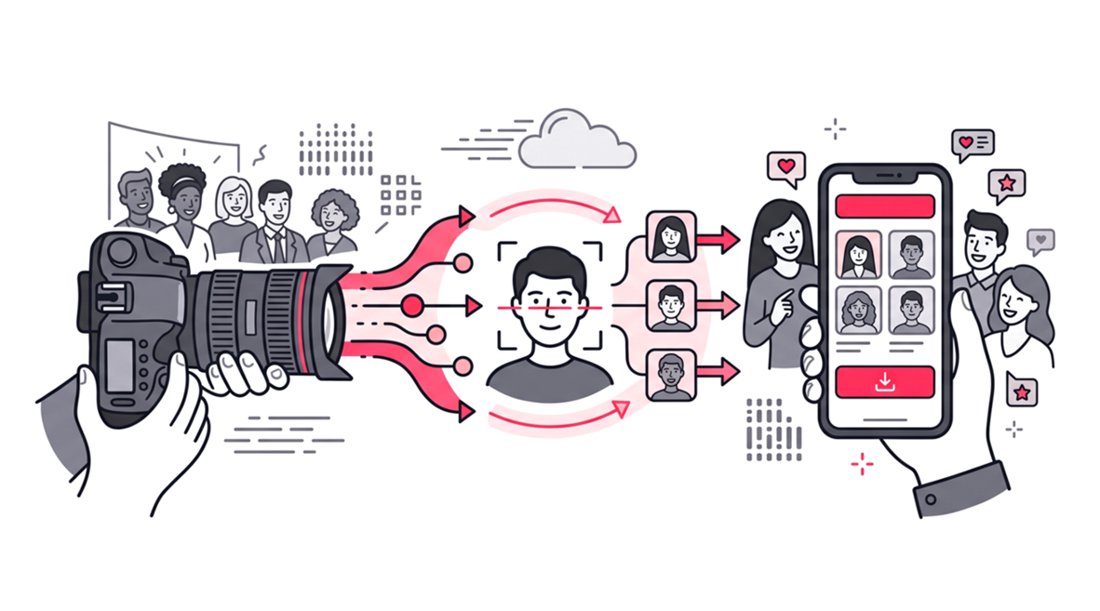
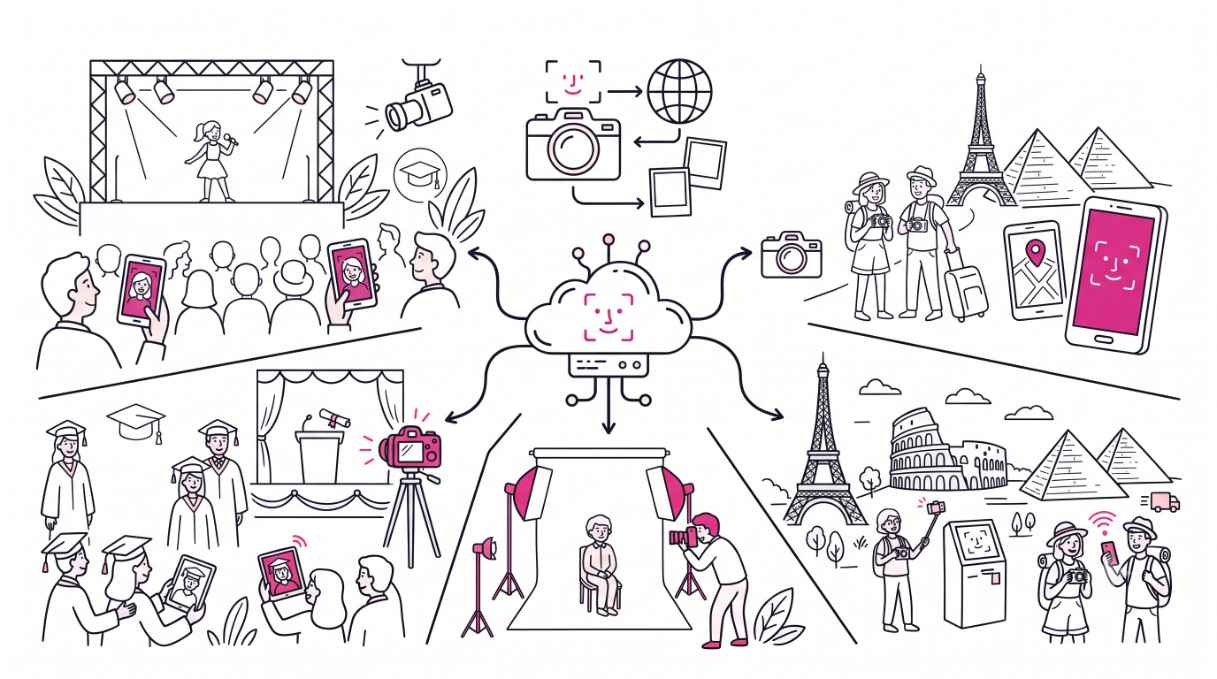
AI event photo sharing benefits the corporate, wedding, education, and sports industries by automating photo distribution through facial recognition. Event managers and photographers use these platforms to instantly match attendees with their pictures via a single selfie upload. This eliminates manual sorting workflows, guarantees instant delivery, and drastically increases social media engagement for any event.
The Evolution of Event Photography Workflows
Finding how to share event photos efficiently has always been a major bottleneck for the event industry. Traditional methods involve scrolling through massive cloud storage folders or waiting weeks for edited galleries. These outdated processes kill post event excitement and limit organic brand reach.
The global photographic services market is projected to reach $40.27 billion in 2026. This growth is heavily driven by the demand for instant digital content and advanced technological integrations. Client expectations have shifted dramatically toward real time access and mobile optimized galleries.
Recent industry data shows that 81% of event attendees now expect same day photo delivery. Photographers cannot meet this demand using manual sorting and basic file sharing links. Adopting AI photo recognition for event photographers bridges this gap and revolutionizes the delivery process.
By adopting an automated event photography workflow, professionals can eliminate hours of administrative work. AI face matching accuracy currently exceeds 95% in modern systems. This precision ensures that every guest finds their moments without frustration.
Key Industries Transformed by AI Photo Sharing
Corporate Conferences and Brand Activations
Corporate events demand high return on investment and measurable brand engagement. When marketers plan a trade show, the visual content generated is a prime asset for future promotions. Unfortunately, traditional delivery methods result in low download rates and missed marketing opportunities.
AI photo sharing changes the dynamic by delivering personalized galleries straight to attendee devices. When guests receive professional photos of themselves instantly, social media sharing increases significantly. Research indicates that real time sharing generates a 400% increase in social media engagement.
Event organizers can also overlay corporate branding or logos on the digital assets before delivery. This transforms every attendee into a micro influencer for the brand. It is an incredibly efficient way to maximize the reach of a corporate gathering.
Weddings and Private Social Gatherings
Weddings are high stakes environments where clients expect absolute perfection and immediate results. The days of sending a single drive link three months after the reception are over. Modern couples and their guests want to see and share their memories while the weekend is still fresh.
Facial recognition allows wedding guests to skip the endless digital scrolling. They simply snap a selfie, and the system filters out every image they appear in. This provides a highly personalized and magical experience for friends and family.
Furthermore, this technology solves a major privacy concern for private events. Guests only gain access to the images featuring their own face. They do not have to sift through hundreds of unrelated portraits to find their moments.
Read more about how AI photo sharing works for wedding events.
Endurance Sports and Marathons
Photographing a marathon involves capturing thousands of moving subjects over several hours. Identifying a single runner in a database of fifty thousand images is a logistical nightmare. In the past, runners had to manually search by bib numbers, which were often obscured or folded.
AI event photo sharing has completely automated this massive sorting task. Runners simply upload a quick selfie at the finish line to find their action shots. The technology recognizes faces despite sweat, sunglasses, and varied lighting conditions.
This speed allows athletes to post their achievements to social media immediately after the race. Event organizers benefit from the instant wave of online visibility. It creates a seamless bridge between physical exertion and digital celebration.
Higher Education and Graduation Ceremonies
Graduations are chaotic events with hundreds of students wearing identical caps and gowns. Capturing the split second a student crosses the stage is stressful for both photographers and parents. Distributing those photos accurately afterward is even more challenging.
With facial recognition photo delivery, universities can streamline the entire distribution process. Families do not have to wait for physical proofs in the mail. They can securely access their graduate’s photos within hours of the ceremony.
This modern approach greatly improves alumni relations and family satisfaction. Universities can ensure their official event photos are the ones being shared online. It protects the institutional brand while providing massive value to the students.
Public Relations and Influencer Events
Influencer marketing relies entirely on speed and visual quality. If an influencer does not receive their professional event photos immediately, they will simply post their own smartphone pictures. Brands lose control of the visual narrative when this happens.
Offering instant AI photo delivery guarantees that influencers use the official, high quality media. They can take a selfie at the venue and immediately download retouched, brand approved images. This keeps the event trending online with premium visual assets.
To learn more about optimizing influencer galleries, check out our guide on how to share event photos. Fast delivery is the ultimate currency in public relations.
The Technical Architecture of Modern Photo Sharing
The Superiority of Web App Environments
Event guests absolutely hate downloading native mobile applications for a single weekend event. Forcing attendees to visit an app store creates massive friction and lowers adoption rates. Modern solutions bypass this problem by operating entirely within a browser environment.
A streamlined web app allows users to access their photos instantly from any smartphone. Guests simply scan a QR code at the venue, open the link, and take a selfie. There are no passwords to remember and no heavy software to install.
This low friction entry point ensures maximum participation from attendees. Event managers see significantly higher gallery engagement when the barriers to entry are removed.
Leveraging the One Way Photo Sharing Model
Many platforms confuse users by allowing collaborative uploads and messy two way syncing. Professional event organizers actually need a strictly one way photo sharing tool to maintain quality control. The platform should function as a distribution channel, not a messy collaborative folder.
In a proper professional setup, the software does not capture media natively or allow guest uploads. The photographer uploads the high resolution files, and the attendees simply retrieve their matches. This protects the integrity of the event gallery and prevents low quality smartphone shots from mixing with professional work.
By utilizing a strict one way photo sharing approach, photographers retain full control over their art. The AI purely handles the logistics of sorting and delivery.
How Facial Recognition Matching Works
The technology behind this workflow is both complex and incredibly fast. When a photographer uploads an event gallery, the AI creates a unique mathematical map for every face detected. It accounts for angles, partial shadows, and varying expressions.
When a guest uploads their reference selfie, the system compares their face map against the entire database. Modern systems can process and match these data points across thousands of photos in under two seconds. The speed and accuracy are virtually flawless.
The resulting personalized gallery is generated dynamically for that specific user. It transforms a massive, overwhelming catalog into a curated personal album.
Measuring the ROI of Instant Photo Delivery
Maximizing Social Media Engagement
The true value of AI photo sharing lies in its marketing potential. When people receive high quality photos of themselves quickly, their first instinct is to post them. This organic sharing acts as free, authentic advertising for the event organizer.
Statistics confirm that real time photo delivery can increase a photographer’s bookings by 58%. Event brands see their hashtags utilized more frequently and with better visual content. The return on investment is immediate and highly visible.
Drastically Reducing Administrative Overhead
Manual culling and sorting can take days of unbillable administrative time. Photographers frequently report an 80% to 90% reduction in delivery time when utilizing AI automation. This allows creative professionals to scale their businesses without hiring extra administrative staff.
By removing the sorting bottleneck, professionals can take on more clients during busy seasons. The technology pays for itself by freeing up valuable calendar hours.
Traditional vs AI Photo Sharing Methods
To fully understand the shift, we must look at the operational differences. The table below highlights how artificial intelligence is replacing legacy distribution methods.
| Feature | Traditional Cloud Links | AI Photo Sharing |
|---|---|---|
| Delivery Speed | Days to weeks after the event | Real time or same day delivery |
| Guest Effort | Scrolling through hundreds of files | One simple selfie upload |
| Privacy Control | Everyone sees all event photos | Guests only see their own photos |
| Marketing ROI | Low engagement, delayed posting | High instant social media sharing |
| Access Method | Complex folders or native apps | Frictionless web app via QR code |
Best Practices for Implementing AI Photo Sharing
Optimizing the Guest Experience
Technology is only effective if attendees actually know how to use it. Event organizers should place clear signage and QR codes around the venue. Brief announcements from the stage or DJ can also drive adoption.
The language used on these signs should focus on the benefit to the guest. Use phrases like “Find your photos instantly with a selfie” to encourage participation. Clear communication guarantees a high match rate.
Securing Guest Privacy and Data
Privacy is a critical component of modern photo distribution. High quality platforms prioritize user consent and data security above all else. The facial recognition process should always be opt in for the attendees.
Professional web apps ensure that biometric data is only used for matching purposes. Once the event cycle is complete, this data is securely purged. Communicating this commitment to privacy builds trust with corporate clients and private guests alike.
FAQ
What is the best way to share event photos?
The best way to share event photos is by using an AI powered web app that utilizes facial recognition. This allows guests to locate their pictures instantly by uploading a selfie, rather than scrolling through massive cloud folders.
How does AI facial recognition photo delivery work?
The AI scans all uploaded event photos to create a mathematical map of every face. When a guest uploads a selfie to the web app, the system matches their face against the database and instantly delivers their personalized gallery.
Do guests need to download an app to get their photos?
No, modern event photo platforms operate entirely as a web app. Guests simply scan a QR code at the venue, open the link in their mobile browser, and take a selfie to access their images.
Is facial recognition photo sharing secure for private events?
Yes, professional platforms use an opt in, one way photo sharing model. Guests can only access the images that feature their own face, which prevents unauthorized users from browsing the entire private event gallery.
How does instant photo delivery improve event marketing?
Instant delivery capitalizes on post event excitement. When guests receive high quality photos immediately, they are 400% more likely to share them on social media, dramatically increasing organic reach for the event brand.
Conclusion
The future of the event industry relies on speed, personalization, and seamless digital experiences. AI event photo sharing has proven to be the most effective way to meet these escalating client demands. By eliminating manual sorting, professionals can focus on capturing great moments and growing their businesses.
Whether you manage corporate summits or photograph intimate weddings, upgrading your delivery workflow is no longer optional. The data clearly shows that attendees expect rapid, personalized access to their memories. Embrace the power of facial recognition to protect your time and amplify your brand reach.
Ready to transform your delivery workflow and delight your clients? Start sharing smarter with SnapSeek today.