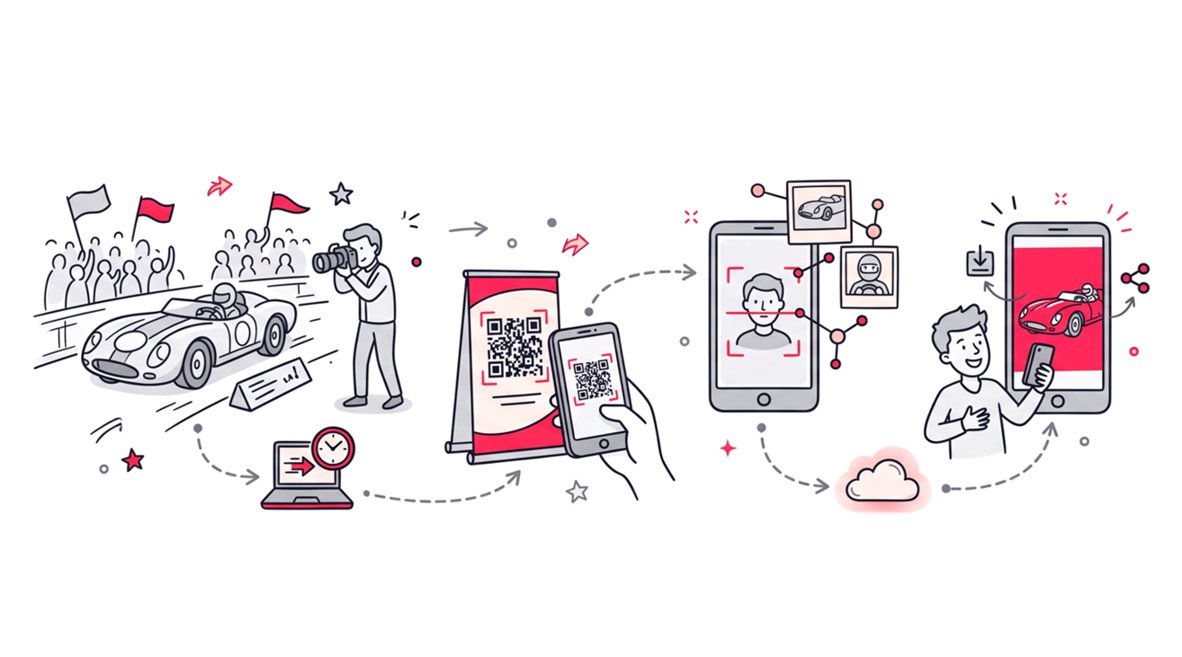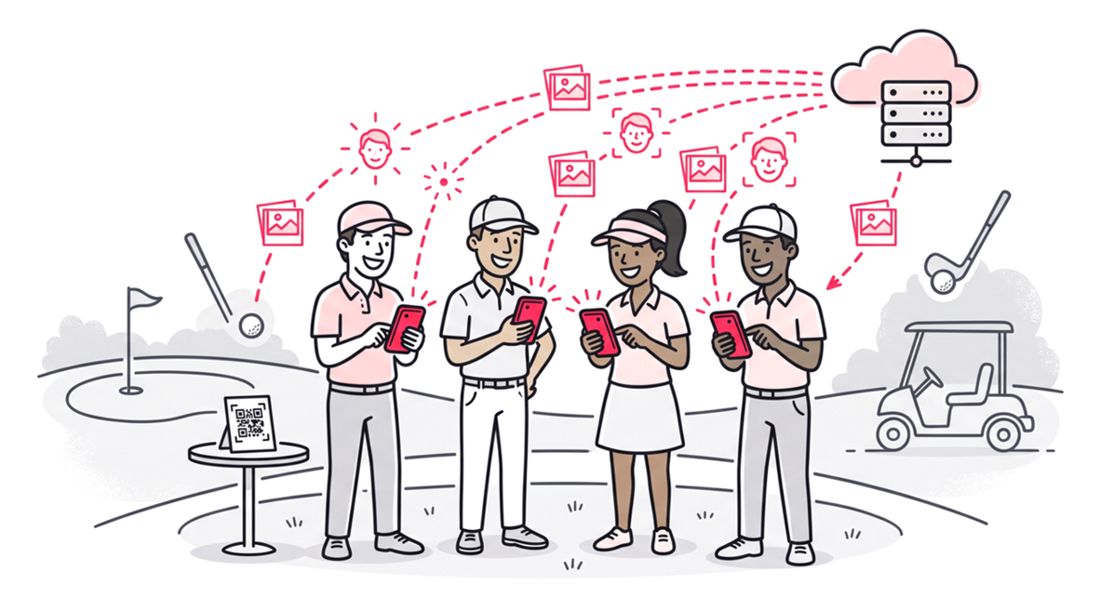
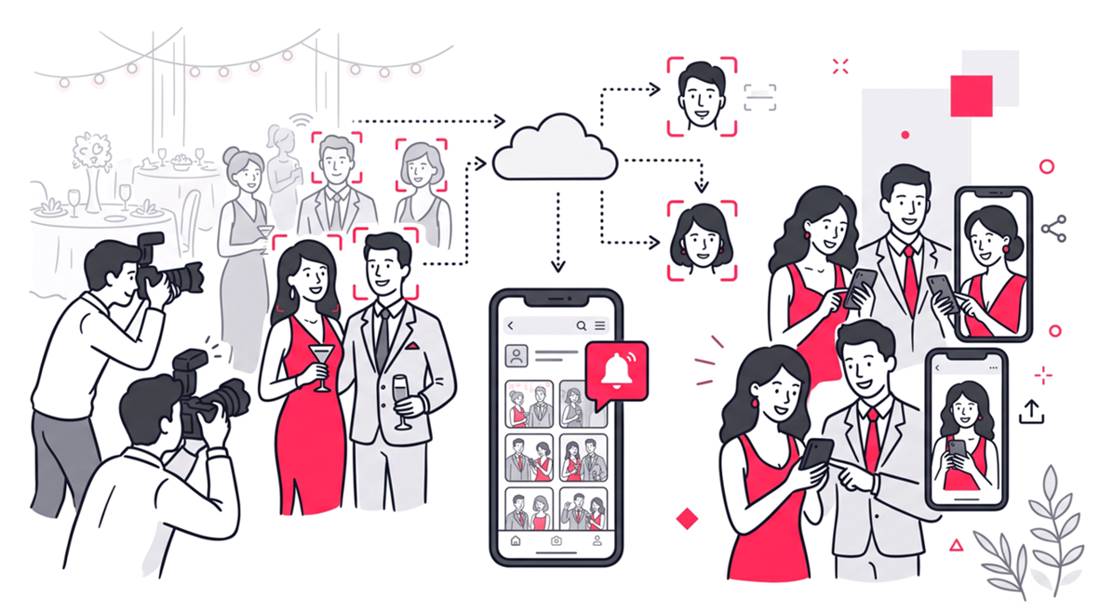
To share fundraiser photos using face recognition, photographers upload their edited event images to an AI-powered web gallery that automatically indexes facial features. Donors and attendees access the platform via a QR code or link, take a quick selfie, and instantly receive their personal photos without scrolling through thousands of gallery images. This streamlined, one-way distribution workflow eliminates search friction, protects donor engagement windows, and drives immediate social sharing.
Fundraisers, charity galas, and donor appreciation dinners operate on tight schedules and high expectations. Professional event photographers capture hundreds or thousands of high-resolution images throughout the evening. Delivering those images to attendees efficiently is where traditional photography workflows often fall apart.
Traditional sharing methods like cloud storage folders and static online galleries force guests to manually search through massive libraries. Incorporating artificial intelligence and facial matching transforms this post-event experience into an automated, high-touch engagement channel for organizers, donors, and photographers alike.
The High Stakes of Non-Profit and Gala Photo Distribution
Fundraising events rely heavily on post-event momentum to maintain donor enthusiasm and reinforce community impact. Visual storytelling plays a central role in this lifecycle. When high-net-worth donors, corporate sponsors, and volunteers receive photos of themselves actively participating, they are substantially more likely to share them online and stay connected with the cause.
The standard delivery window for event photos has historically ranged from three to ten days. Industry data indicates that attendee engagement drops by over 60% if photos are delivered more than 48 hours after an event concludes. When guests receive a generic gallery link weeks later, the emotional resonance of the evening has already faded.
Large fundraisers also present a volume problem. A typical four-hour gala with 400 guests can easily yield 1,500 to 3,000 delivered photos. Expecting busy donors to browse dozens of pages to locate two or three pictures of their table is an outdated user experience that depresses engagement rates.
How AI Face Recognition Photo Sharing Works
AI-powered photo distribution replaces manual searching with computer vision and vector-based facial matching. Modern algorithms analyze facial landmarks, such as the distance between the eyes, nose bridge geometry, and cheekbone contours, converting these coordinates into mathematical representations known as face embeddings.
First, the event photographer uploads the full event gallery in a batch. Next, the AI indexing and processing system detects faces, generates embeddings, and groups matches. Donors then gain access by scanning an on-site QR code or opening a direct link to snap a quick reference selfie via their browser. Finally, the system delivers instant results, returning matching photos in sub-second time.
When a photographer uploads the event collection to a modern event photo sharing platform, the backend processing engine runs face detection across the entire batch. It groups matching faces and indexes each image without requiring manual tagging or metadata naming.
On the attendee side, the interaction takes seconds:
- The guest scans an on-site QR code placed on dinner tables or event signage.
- The guest opens a browser page and uploads a quick selfie.
- The matching engine compares the selfie’s facial vector against the indexed event database.
- The platform isolates and displays only the photos containing that specific individual.
This entire sequence operates via a web browser without requiring guests to download third-party mobile applications from app stores.
Comparing Fundraiser Photo Distribution Methods
Selecting the right distribution model directly impacts how donors perceive the professionalism of the event. The table below outlines how traditional storage and proofing systems compare against specialized AI face-matching platforms.
| Feature / Metric | Cloud Storage Links (Drive / Dropbox) | Traditional Proofing Galleries | AI Face-Matching Web Platforms |
|---|---|---|---|
| Search Experience | Manual scrolling through unsorted folders | Manual grid browsing and category filtering | Sub-second AI selfie match |
| Attendee Friction | High: Requires account login or desktop viewing | Moderate: Requires pagination through hundreds of shots | Ultra-low: Instant browser access via QR code |
| Donor Lead Capture | None | Basic email gate (often skipped) | Customizable integrated lead capture forms |
| Delivery Speed | Manual batch link generation | Hours to build complex web proofs | Automated real-time indexing upon upload |
| Mobile Optimization | Poor: Clunky mobile web layouts | Moderate: Responsive web, but heavy bandwidth draw | High: Lightweight, mobile-first web interface |
| Social Amplification | Low: High friction prevents quick downloads | Low to Moderate: Slow download workflows | High: Donors grab photos in seconds and post immediately |
For an in-depth look at how cloud drives fall short during live gatherings, read our guide on why Google Drive fails at live event photo sharing.
Step-by-Step Guide: Implementing Face Recognition at a Fundraiser
Executing an automated photo distribution strategy requires minimal adjustments to your existing photography and event management workflow. Follow these five practical steps to set up seamless face recognition delivery.
1. Curate and Upload the Gallery
Complete your standard culling and color correction process in Lightroom or your preferred editing suite. Export the final high-resolution JPEGs and upload them directly to your platform gallery. Ensure that all photos are well-lit and that group shots maintain sharp focus so the facial detection engine can accurately map every individual in the frame.
2. Set Up QR Codes and Table Signage
Deploy on-site access points before the event begins. Place elegant table cards, digital signage slides, or program inserts featuring a dedicated QR code that routes directly to your branded event gallery URL. Positioning signage near registration tables, bars, and silent auction areas guarantees maximum visibility.
3. Configure Lead Capture for Donor Relations
Non-profit organizations thrive on donor retention and contact discovery. Modern platforms allow organizers to integrate customizable lead capture fields before attendees run their facial search. Collecting a first name, last name, and email address turns photo delivery into a high-value donor acquisition channel for the foundation.
4. Enable Automated Email Notifications
For galas where photos are uploaded during or immediately after the event, configure automated notification workflows. When donors submit their reference selfie, the system records their matching profile. As soon as the photographer uploads additional photo batches, the platform can automatically dispatch an email alert linking the donor directly to their updated photo collection.
5. Follow Up with Giving Links and Impact Stories
Coordinate with the non-profit communications team to pair the photo delivery gallery with fundraising initiatives. When donors view their personal pictures, include direct links to donation pages, charity auction payment portals, and post-event recap videos. Connecting personal visual memories to ongoing contributions drives tangible financial results.
Key Benefits for Event Photographers and Non-Profits
Adopting an AI-driven workflow provides clear operational advantages for both the creative vendor and the hiring organization.
For event photographers, this system eliminates manual image sorting and facilitates rapid gallery delivery, enabling a clean client handoff. The ability to offer instant, AI-based matching also acts as a premium service upsell that differentiates their business. Modern distribution web tools maintain image clarity and visual integrity throughout the processing lifecycle, ensuring your portfolio work looks pristine on every device.
For non-profit organizations, the instant delivery workflow drives higher donor engagement and creates a seamless opportunity for lead capture. Additionally, it maximizes viral social reach and extends the overall campaign ROI as attendees share their branded memories online.
For more strategies on optimizing gallery distribution, explore our breakdown on best practices for galas and trade shows.
Why Browser-Based Web Apps Outperform Mobile Apps
A critical factor in event technology adoption is removing user friction. Forcing gala attendees to download a standalone mobile application from the Apple App Store or Google Play Store creates an immediate barrier that drastically lowers participation.
Studies show that over 80% of event guests abandon processes that require installing a dedicated application for single-day use. Friction points include forgotten app store passwords, cellular data constraints, and reluctance to grant wide-ranging device permissions.
Browser-based web applications eliminate these hurdles entirely. Guests simply scan a QR code using their native smartphone camera, launch a secure web page, take a selfie directly within the browser, and download their high-resolution photos immediately.
Streamlining Non-Profit Events with SnapSeek
SnapSeek is designed specifically as an AI-powered, browser-based photo distribution platform for event professionals and organizations. It simplifies gallery management while providing an ultra-fast, modern experience for attendees.
Here is how SnapSeek elevates fundraising events:
- One-Way Host Distribution: SnapSeek operates as a dedicated distribution tool where only the host or photographer uploads gallery assets. This maintains complete artistic and editorial control while preventing unauthorized guest uploads from cluttering the official gallery.
- Zero App Installation: Guests interact with a lightweight web interface that works smoothly across all mobile and desktop browsers.
- Automated Face Grouping: High-speed AI algorithms process large photo volumes in minutes, organizing images into indexed facial profiles instantly.
- Selfie Email Alerts: Attendees can register their selfie once and receive automated email alerts as new batches of gala photos are processed and published.
- Custom Lead Capture: Non-profits can capture attendee names and email addresses directly within the photo retrieval workflow to support post-event development efforts.
- Transparent One-Time Purchase: Instead of locking organizations into complex monthly subscriptions, SnapSeek utilizes a straightforward one-time purchase model per event, making budget approvals effortless for non-profit boards.
- Uncompromised Quality: The platform processes and serves photos so that visual sharpness, color accuracy, and overall image quality remain fully intact.
FAQ
How accurate is AI face recognition in low-light gala settings?
Modern face-matching algorithms rely on geometric facial vectors rather than surface lighting alone. As long as the photographer captures properly exposed images, the system accurately detects and matches faces even in mood-lit banquet halls.
Do donors need to create an account or download an app to find their photos?
No. High-performing platforms like SnapSeek run entirely in standard web browsers. Guests simply scan a QR code, upload a reference selfie through the web page, and view their matched pictures immediately without creating passwords or installing mobile apps.
Can non-profits collect donor emails through the photo sharing process?
Yes. Event organizers can activate customizable lead capture forms that require attendees to enter their name and email address before viewing or downloading their matched photo gallery. This provides non-profits with clean contact data for future outreach.
Is facial recognition photo sharing secure and private for private galas?
Yes. Secure platforms use temporary facial embeddings strictly to match guests with their corresponding event pictures. Biometric data is not sold or shared, and attendees only access photos associated with their own facial profile or the public gallery link designated by the host.
What is the difference between one-way photo sharing and collaborative albums?
One-way photo sharing gives the photographer and host exclusive control over which images appear in the official collection. Collaborative albums allow any guest to upload unvetted smartphone photos, which often results in poor quality, duplicates, and inconsistent branding.
Conclusion
Distributing photos at high-stakes fundraisers should not involve cumbersome cloud links, lost emails, or endless manual scrolling. AI face recognition technology bridges the gap between professional photographers and engaged donors, delivering personalized memories in seconds.
By removing friction with a browser-based, one-way distribution workflow, non-profits can maximize donor goodwill, capture valuable contact details, and amplify their cause across social networks while the event is top of mind.
Upgrade your next charity gala or corporate fundraiser with instant, automated photo sharing. Explore SnapSeek today to deliver an unforgettable digital experience for your clients and donors.