Event photography is fundamentally about capturing memories and delivering them to attendees quickly. Yet the delivery process is often the weakest link in the entire professional workflow. Photographers and event organizers frequently force guests to download clunky applications just to view their pictures.
This creates unnecessary friction and severely damages the overall user experience. You need a better way to handle seamless photo sharing without erecting digital roadblocks. To explore all the modern strategies for app-free photo sharing options, organizers can easily deploy web-based links and instant QR codes. Modern solutions prioritize accessibility over complex software installations.
Transitioning to a frictionless web application completely transforms how your clients interact with your work. Attendees expect immediate results without jumping through hoops. Eliminating the download requirement is the first step toward maximizing your gallery engagement.
The Hidden Costs of Friction in Event Photography
Every extra step you ask a guest to take reduces the likelihood they will view your photos. Friction in digital experiences directly correlates with lower interaction rates. When you add barriers, you diminish the perceived value of your photography service.
The Psychology of Instant Gratification
Attendees at corporate conferences or weddings want their photos immediately. They are excited about the event and want to share their experiences on social media while the energy is still high. Delaying this process kills the momentum.
Providing instant gratification requires a streamlined delivery mechanism. If a guest has to wait until they get home to download software on a stable Wi-Fi connection, they will likely forget. Speed of access is just as important as the quality of the image.
Why the App Store Acts as a Roadblock
Forcing an app download demands significant effort from your guests. They have to navigate to their respective app store, search for the correct photo sharing app, and authenticate their download. This entire process pulls them out of the live event experience.
Many guests will simply abandon the effort halfway through out of frustration. The app store is fundamentally a roadblock designed for long-term software adoption, not transient event interactions. You must bypass this gatekeeper to ensure maximum visibility.
The Storage Space Dilemma for Guests
Modern smartphones are frequently pushed to their absolute storage limits. When guests are prompted to download yet another application, they often face a dreaded full storage notification. They are then forced to delete personal content just to accommodate your delivery method.
This creates immediate frustration before they even see a single image. You never want your professional services associated with a negative user experience. Bypassing downloads entirely respects your client’s hardware limitations.
Why Traditional Mobile Apps Kill Guest Engagement
The traditional software model relies on capturing users within a walled garden. While this works well for daily utility software, it fails miserably for occasional event galleries. Mobile apps introduce too many variables that can derail the viewing process.
Account Creation and Password Fatigue
Mobile applications almost always require users to create an account before accessing any content. Guests must input their details, verify their email address, and memorize yet another password. This process is exhausting and highly detrimental to engagement.
Password fatigue is a real phenomenon that stops users in their tracks. A streamlined web platform removes these account creation hurdles entirely. Guests get straight to the photos without surrendering their data to a mandatory profile setup.
Cross-Platform Inconsistencies
Developing and maintaining a native application for both iOS and Android is notoriously difficult. Often, the experience on one operating system is vastly inferior to the other. This leads to frustrated guests who feel left out due to their device preference.
A web application works seamlessly across all operating systems and browsers. You never have to worry about device compatibility or missing software updates. Every guest receives the exact same high-quality interface regardless of their chosen hardware.
The Abandonment Rate of Heavy Software
Heavy software applications require significant bandwidth to download and install. If an event venue has poor cellular reception, guests will be unable to access the required photo sharing app. They will give up and move on.
Web applications load incrementally and require significantly less data. This makes them far more resilient in crowded environments with congested networks. Lighter software translates directly to higher completion rates.
The Power of a Frictionless Web Application Approach
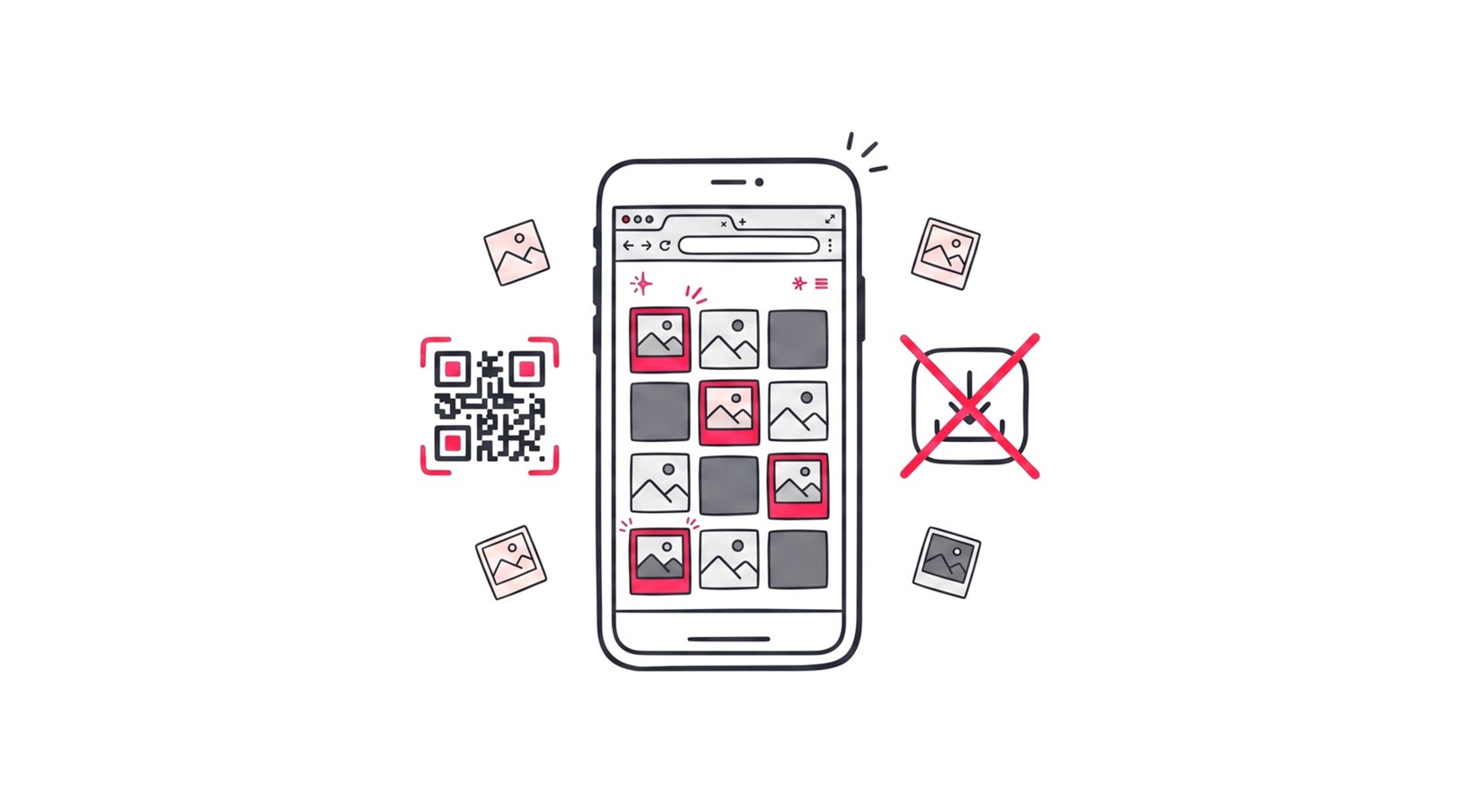
A web application operates entirely within the native browser of a smartphone or computer. There is nothing to install, configure, or troubleshoot. This approach instantly modernizes your delivery strategy and maximizes guest interaction.
Embracing Browser-Based Convenience
Web apps provide immediate access to digital galleries with a single tap. Guests simply click a link and land directly on your professional photo platform. They get instant gratification without sacrificing any advanced functionality.
SnapSeek is built specifically as a web application rather than a mobile app. This architectural choice guarantees that anyone with a smartphone can access their memories instantly. It is the cornerstone of modern event photography delivery.
Instant Access via QR Codes
Generating printable posters instantly transforms how attendees access their pictures. You can place customized QR codes on reception tables, event screens, or exit doors. Guests just scan the code with their camera and their browser opens the gallery automatically.
This physical touchpoint bridges the gap between the real world and your digital assets. You can learn more about how to share event photos with attendees using a QR code to optimize this strategy. For example, high-profile sports and corporate events implement custom setups like golf tournament photo delivery systems to provide zero-friction QR code access on golf carts and venue signage. It is incredibly effective for large gatherings.
Modernizing the Delivery Strategy
Moving away from native apps signals to your clients that you utilize cutting-edge technology. It demonstrates respect for their time and technical boundaries. A streamlined approach elevates your brand above competitors who still rely on outdated portals.
How to Share Event Photos With a Large Crowd Using AI
Delivering images to thousands of attendees used to require massive logistical planning. Traditional methods fail completely when scaling up to enterprise levels. You need smart technology to handle heavy volume without breaking a sweat.
The Limitations of Manual Sorting
Scrolling through thousands of images to find specific people is a terrible use of time. Photographers waste hours attempting to group photos by department, family affiliation, or VIP status. This manual labor delays delivery and frustrates clients who expect rapid turnarounds.
If you are dealing with massive multi-day festivals, manual organization is simply impossible. You need intelligent software to replace human sorting. We discuss this heavily in our guide on how to organize event photos for better sharing experience for those managing high volumes.
Introducing AI Selfie Search
The best AI photo sharing platforms utilize advanced facial recognition to automate the discovery process. Guests simply take a live selfie or upload one from their device upon entering the web app. The platform instantly matches their face against the massive event album.
They find every photo they are in within seconds without scrolling through irrelevant galleries. If you want a deeper dive into this technology, read our breakdown of a face recognition app to find photos in shared albums. It completely redefines the viewing experience.
Seamless Photo Sharing at Scale
Facial recognition allows you to manage massive corporate summits effortlessly. The technology handles the heavy lifting of sorting and filtering automatically in the background. You can scale your business to handle larger crowds without increasing your post-production hours.
Understanding the Mechanics of AI Selfie Search
Demystifying how facial recognition works can help you sell the feature to hesitant clients. The technology is highly sophisticated but incredibly easy for the end user to operate. It bridges the gap between massive data sets and individualized curation.
Live Selfies vs Camera Roll Uploads
Guests have the option to snap a quick photo in real time or select a favorite picture from their existing camera roll. The AI analyzes the unique geometry of their face to create a secure, temporary matching profile. This flexibility ensures high adoption rates across all demographics.
Navigating Complex Lighting and Angles
Professional event photography often features dramatic lighting, silhouettes, and candid profiles. Top tier facial recognition algorithms are trained to identify subjects even in poor lighting conditions. The software can accurately match faces even if the subject is looking slightly away from the lens.
Privacy-Centric Matching Technology
Privacy is paramount when dealing with biometric matching. The AI matches faces mathematically without identifying personal details. Once the event cycle concludes, the facial data is securely purged to maintain strict privacy standards.
Step-by-Step Guide to App-Free Photo Delivery
Transitioning to a web-based delivery model is incredibly straightforward. It requires minimal setup and integrates directly into your existing export workflow. Here is how you can streamline your process today.
Step 1: Upload to a Web-Based Platform
Start by exporting your edited files and uploading these high-resolution images directly to your secure cloud infrastructure via your web browser. SnapSeek supports large file sizes to ensure professional quality is always preserved upon delivery.
Step 2: Utilize Face Detection Technology
Enable automatic face detection once the upload is complete. The system will scan the entire gallery and group faces without any manual tagging required. This automated indexing is the secret to unlocking instant retrieval for your guests.
Step 3: Distribute Using Simple Collection Links
Generate a unique URL or a QR code for the gallery and share it directly with your event organizer. You can also utilize physical signage to display the QR code. Guests access the gallery via their browser, totally bypassing the need for a dedicated application.
Top Features of the Best AI Photo Sharing Platforms
Not all browser-based platforms offer the same level of utility for professional creators. You need specific tools that empower photographers to monetize and market their services. The right features turn a simple gallery into a powerful business asset.
Automated Watermarking and Branding
Protecting your intellectual property and promoting your brand is vital. Look for software that offers customizable watermark positioning and opacity controls. This ensures your logo is visible on every shared image without ruining the composition.
You should also integrate your website and social links directly into the gallery interface. Discover how to use custom branding in event photography via SnapSeek to elevate your professional presence. Consistent branding drives referral traffic.
Email Capture and Lead Generation
Your photo gallery should serve as an automated lead generation tool. By optionally prompting guests to enter their email before viewing their pictures, you build a highly valuable contact list. You can leverage these localized leads for future marketing campaigns.
Real-Time Notifications
Guests can opt in with a quick selfie to stay updated as new images are processed throughout the night. The AI automatically matches new uploads to active subscribers in real time. They receive an instant email delivery the moment their pictures hit the server.
Comparing Event Photo Delivery Methods
Choosing the right tool is critical for your workflow efficiency. Many photographers rely on generic file sharing services that were never designed for visual media or large crowds. Let us look at how different methods stack up.
| Feature | SnapSeek (Web App) | Mobile Apps | Generic Cloud Drives |
|---|---|---|---|
| App Download Required | No | Yes | Sometimes |
| AI Face Recognition | Yes | Varies | No |
| One-Way Upload Control | Yes | Varies | Varies |
| Instant QR Access | Yes | No | No |
| Automated Email Capture | Yes | Yes | No |
As the table shows, a dedicated web platform offers the most comprehensive feature set for live events. If you are still using legacy folder systems, check out our breakdown of a Google Drive alternative for smart event photo sharing. It highlights the massive functional gaps in traditional cloud storage.
Maximizing Post-Event Marketing Without an App
A web-based gallery is a dynamic marketing environment, not just a digital storage box. It allows you to maintain momentum and interact with attendees long after they leave the venue. Smart organizers use this to drive future revenue.
The Follow-Up Strategy
Use the emails collected during the gallery access phase to send targeted follow up campaigns. You can offer discounts on print orders or promote your photography services for their next gathering. A frictionless web entry ensures you capture a significantly higher volume of leads.
Leveraging High Resolution Support
Providing full resolution downloads builds immense goodwill with attendees and event planners. They appreciate the ability to print or share crystal clear images on their social networks. When they post these high quality photos, your integrated branding travels with them.
Building Your Personal Brand
Every interaction a guest has with your gallery reflects on your brand. A smooth, fast, app-free experience positions you as a premium service provider. This professional polish directly leads to repeat bookings and high-value referrals.
FAQ
How do guests find their photos without an app?
Guests simply scan a QR code or click a direct link to open the gallery in their native web browser. They can then upload a quick selfie to let the AI facial recognition instantly locate all their pictures.
Can attendees upload their own photos to the event gallery?
No. The platform utilizes a strict one-way distribution model to maintain gallery quality. Only the host or the official photographer has permission to upload content.
Is facial recognition safe to use for private events?
Yes. Privacy-centric AI matches faces without identifying personal information or storing sensitive data long-term. Collections are also private by default and can be secured with optional access passwords.
What makes a web app better than a standard mobile app for photo delivery?
A web app requires zero downloads, zero account creations, and takes up no storage space on a user device. This completely eliminates access friction and significantly boosts the number of guests who actually view the gallery.
How does AI search handle large crowds at corporate conferences?
The automatic face detection software scans massive albums in seconds. It completely eliminates manual sorting by instantly delivering customized, personal galleries to each attendee based on their unique facial profile.
Conclusion
Forcing attendees to download clunky software is a relic of the past. A seamless photo sharing experience relies on removing barriers and embracing the speed of modern web applications. By utilizing AI sorting and strict one-way distribution, you maintain complete control over your professional output while maximizing guest satisfaction.
Stop losing guest engagement to tedious app store downloads, storage limits, and mandatory account creations. Choose a smarter, faster way to deliver your hard work to the people who matter most. Try SnapSeek today and transform your event photography workflow with frictionless, browser-based delivery.