Organizations need event photo sharing to streamline content delivery, maximize digital asset ROI, and amplify brand reach. A modernized photo management workflow enables businesses to seamlessly distribute high-quality images to stakeholders, sponsors, and attendees immediately after an event. By adopting intelligent photo delivery at organizations, marketing teams can boost social engagement while reducing the manual friction of sorting and curating large media libraries.
The Evolution of Corporate Event Photography
Event photography is no longer just about capturing memories. It is a fundamental component of corporate marketing and stakeholder engagement.
Modern businesses rely on high-quality visuals to drive their digital presence. From annual corporate summits to large-scale trade shows, every interaction is a branding opportunity.
However, capturing the photos is only half the battle. The real challenge lies in the photo sharing workflow for businesses.
Marketing teams often find themselves drowning in thousands of raw files. Without a streamlined digital asset management system, delivering the right photo to the right person becomes an administrative nightmare.
Analyzing Current Workflows and Their Limitations
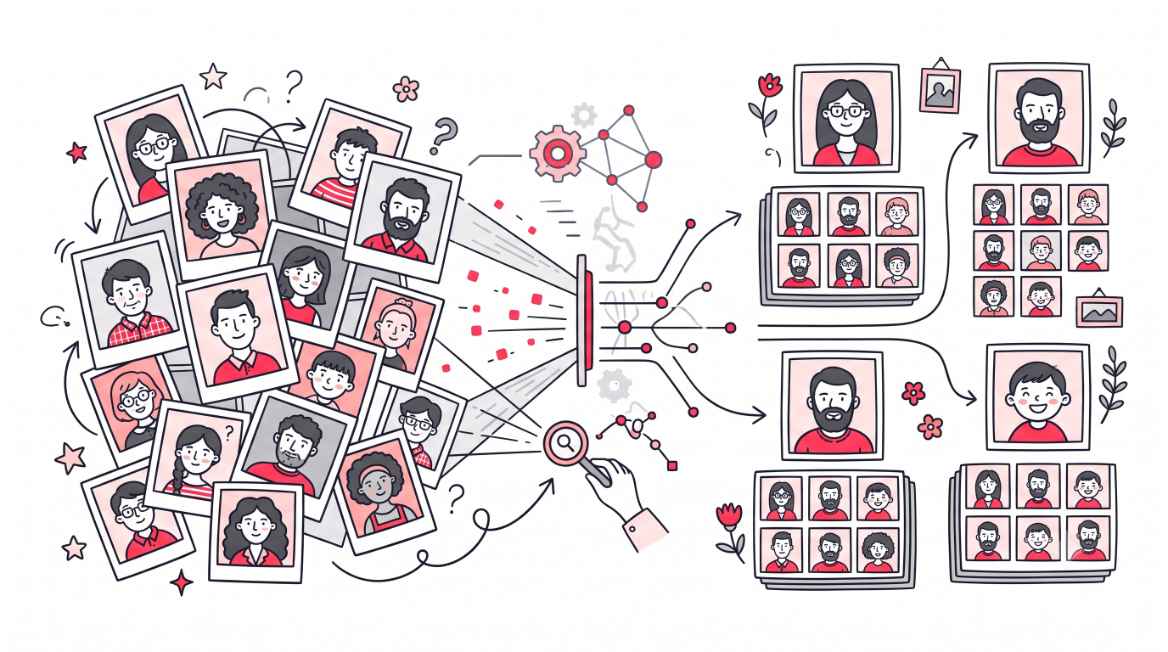
Traditionally, photographers upload massive galleries to generic cloud storage platforms. They send out broad access links, leaving attendees to scroll through hundreds of images to find themselves.
This archaic approach to photo delivery at organizations creates massive friction. It wastes time for both the marketing department and the end user.
Security is also a major concern when using unprotected folders. Corporate events often contain sensitive intellectual property that should not be publicly accessible.
When a public link is shared, organizers lose control over their digital assets. Competitors can easily scrape unbranded images for their own purposes.
You can explore more about securing your visual assets in our deep dive on secure photo sharing workflow.
The Scale of Business Photo Management
The digital asset management market is expanding rapidly, underscoring the vital need for better infrastructure. According to IMARC Group, the global digital asset management market was valued at $8.9 billion in 2025. It is projected to reach $32.8 billion by 2034.
Similarly, the event photography and videography services sector was valued at $9.05 billion in 2025. It is expected to hit $9.77 billion by the end of 2026.
This explosive growth proves that visual content is the backbone of modern corporate communication. Organizations are investing heavily in event photography to fuel their omnichannel marketing campaigns.
But this massive scale requires sophisticated photo management. When a single conference generates ten thousand images, manual sorting is mathematically impossible.
Marketing departments need scalable solutions that grow alongside their data requirements. Intelligent photo management software bridges the gap between raw capture and final distribution.
How AI Automates the Sorting Process
Artificial intelligence has revolutionized how we handle bulk imagery. Industry data shows that 87% of professional event photographers now utilize AI-powered tools.
Facial recognition algorithms can achieve up to 99.5% accuracy. This technology allows platforms to instantly categorize images based on the individuals present in the frame.
For a corporate marketing team, this means attendees get their specific photos delivered directly to their smartphones. This instant gratification drives immediate social sharing.
Event industry statistics from 2026 reveal that personalized photo delivery increases attendee retention. Organizers who deliver branded, personalized photos see a 36% higher rate of attendees returning for future events.
Events That Demand Optimized Photo Sharing
Different organizations have distinct needs when it comes to visual content. However, the requirement for speed and security remains constant across all sectors.
Corporate Summits and Trade Shows
These massive events involve thousands of delegates, keynote speakers, and sponsors. Sponsors demand immediate access to high-quality photos to validate their investment.
A seamless photo sharing architecture allows event managers to distribute curated albums to VIPs in real time. Learn more about optimizing sponsor visibility in our guide on maximizing trade show engagement.
University and Educational Galas
Alumni events and graduation ceremonies generate highly emotional, personalized content. Educational institutions use these images for fundraising campaigns and prospective student marketing.
Delivering photos directly to alumni fosters a strong sense of community. It also provides the marketing department with user-generated content that performs exceptionally well on social media.
Brand Activations and PR Stunts
Consumer facing brands thrive on virality. If a photo from a PR stunt is not shared within the first 24 hours, its marketing value plummets.
Brands need photo delivery systems that remove all friction for the consumer. Attendees should be able to scan a QR code and immediately receive their branded photos ready for Instagram or LinkedIn.
Non-Profit Fundraisers and Galas
Charity events rely heavily on post-event momentum to drive continuous donations. High-quality images of donors and beneficiaries need to be distributed rapidly to maintain engagement.
Automated photo sharing allows non-profits to instantly thank their high-net-worth donors with professional portraits. This personal touch significantly increases the likelihood of recurring contributions.
Structuring a Bulletproof Photo Sharing Workflow
Transitioning to a modern photo sharing workflow for businesses requires a strategic shift. It begins by treating photos as high-value data assets rather than mere souvenirs.
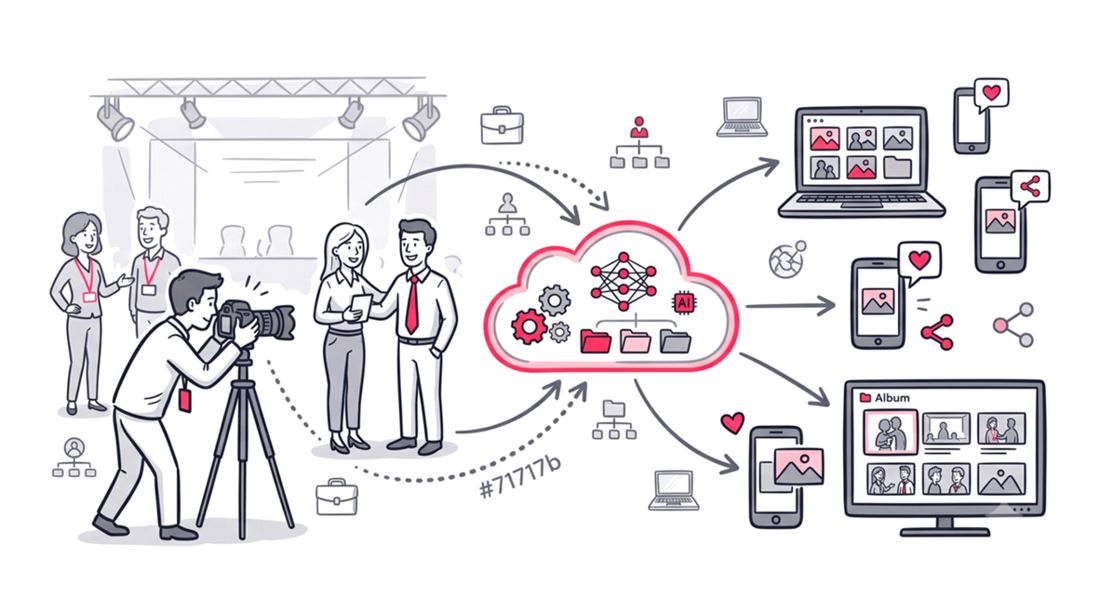
The workflow must be carefully mapped out before the event begins. This ensures a seamless transition from the photographer’s camera to the attendee’s smartphone.
Step 1: Pre-Event Strategy and Integration
First, establish clear guidelines with your event photographers. Ensure they understand the technical requirements for real-time uploading and metadata tagging.
Your marketing team should configure the photo management platform in advance. This includes setting up custom branded galleries, watermarks, and desired form of photo delivery.
Step 2: Live Capture and Immediate Processing
During the event, photographers should utilize wireless tethering or drag and drop method to upload the images to the cloud. The goal is to get images into the cloud infrastructure as quickly as possible.
Once uploaded, the artificial intelligence engine takes over. It automatically detects faces, categorizes, and tags photos based on pre-approved facial recognition databases.
Step 3: Automated Delivery and Data Capture
Finally, the system triggers notifications to attendees via email. They receive a secure link containing only the photos they appear in.
Simultaneously, the system captures essential data for post-event campaign. It includes capturing data from attendees and utilizing it for creating targeted marketing campaigns.
Evaluating Photo Sharing Software
Choosing the right software infrastructure is critical for your organizational workflow. Not all platforms are built to handle enterprise-level demands.
You must look for tools that prioritize data privacy, rapid server delivery, and intuitive user interfaces. Below is a technical comparison of traditional storage versus intelligent event photo sharing.
| Feature | Traditional Cloud Storage | Intelligent Photo Sharing |
|---|---|---|
| Delivery Speed | Manual sorting required | Instant AI-driven delivery |
| User Experience | Scrolling through endless folders | Direct delivery via facial recognition |
| Security | Broad link sharing | Granular access control and privacy masking |
| Brand Integration | None | Custom watermarks and branded galleries |
The Hidden Costs of Poor Photo Management
Many organizations underestimate the financial drain of inefficient photo management. When digital assets are poorly organized, employees waste countless hours searching for specific files.
The frustration of navigating chaotic folders leads to abandoned marketing campaigns. High-quality images sit dormant on hard drives instead of generating leads on social media.
Furthermore, manual photo sorting requires dedicated administrative staff. Paying employees to manually tag and email photos is a massive misuse of corporate resources.
By digitizing and automating this workflow, organizations reclaim hundreds of administrative hours. They also guarantee that their visual content reaches its maximum potential audience.
Overcoming Data Privacy Concerns
Data privacy is the most common hesitation organizations face when adopting facial recognition software. Corporate legal teams are rightfully protective of attendee data.
It is crucial to partner with software providers that prioritize compliance. Your chosen platform must adhere strictly to global data protection regulations.
Intelligent platforms utilize closed-loop facial recognition. This means biometric data is only used temporarily to match photos and is never sold or shared with third parties.
Clear opt-in policies at registration ensure complete transparency. Attendees must have the option to easily exclude themselves from the automated sorting process.
Read more about how facial recognition works in the event industry.
FAQ
Why is photo management important for large organizations?
Photo management ensures brand consistency, secures sensitive visual data, and maximizes the marketing ROI of event photography. It eliminates manual sorting, allowing teams to deploy visual assets quickly across PR and social channels.
How does AI improve event photo sharing?
AI utilizes advanced facial recognition to scan thousands of event photos in seconds. It automatically groups images by person, enabling attendees and stakeholders to instantly receive personalized galleries without manual searching.
What are the security risks of traditional photo sharing?
Using generic cloud links exposes corporate events to data breaches and unauthorized downloads. Advanced photo delivery systems use secure, targeted access controls to ensure only authorized individuals view specific event assets.
What is the ideal photo sharing workflow for businesses?
The ideal workflow involves live photo upload, instant AI processing, and automated personalized delivery to attendees. This removes friction, accelerates social sharing, and significantly reduces administrative overhead for marketing teams.
Conclusion
Event photo sharing for business and organizations is no longer a post-event afterthought. It is a critical infrastructure requirement for modern marketing, branding, and stakeholder engagement.
By abandoning outdated manual workflows, businesses can unlock the true value of their visual assets. Implementing automated, secure, and intelligent systems ensures that every photo captured works tirelessly to promote your brand.
Streamline your organizational workflow today. Discover how SnapSeek can completely transform your event photo delivery.